Understanding what goes into our bark means starting at the beginning: with soil, with climate, and with an ecosystem in the highlands of southern Mexico that has been shaping this plant — and the people who depend on it — for centuries.
The Maya Called It Tepezcohuite
Long before there was a commercial market for Mimosa hostilis root bark, the Maya of Chiapas already knew exactly what it was capable of. They called it Tepezcohuite — the skin tree — and used powdered bark to treat burns, wounds, and skin conditions with results reliable enough to pass the knowledge down through generations. That tradition proved so durable that when the 1985 Mexico City earthquake left thousands without access to conventional medicine, Tepezcohuite became an emergency field treatment deployed across the city. The Mexican government subsequently recognized it as part of the country's national heritage.
Across the Americas in northeastern Brazil, indigenous communities arrived at the same plant by a completely different path, calling it Jurema Preta — Black Jurema — and weaving it into ceremony, medicine, and textile craft across centuries of independent tradition. Two cultures, thousands of miles apart, trusted the same root bark with the same problems.
Two cultures, thousands of miles apart, trusted the same root bark with the same problems. That is not coincidence. That is chemistry.
The region that produces our bark — and that we consider the gold standard for quality — is the Selva Baja Caducifolia of the Depresión Central de Chiapas.
The Selva Baja Caducifolia — Chiapas's Dry Forest
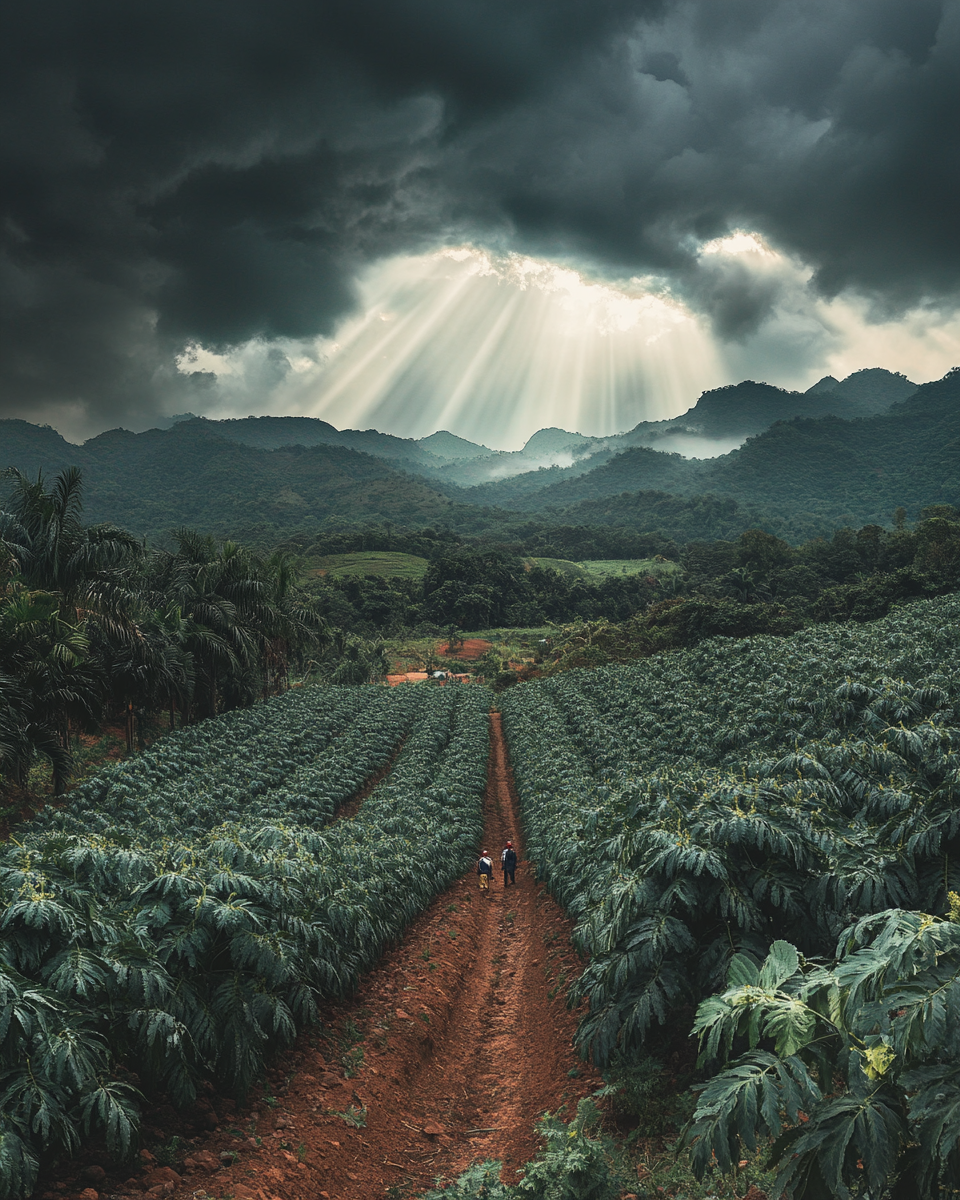
The Depresión Central de Chiapas — the Central Depression — is a vast formation running through the heart of the state at elevations between roughly 420 and 800 meters, flanked by the Chiapas plateau to the east and the eroded slopes of the Sierra Madre to the west. The ecosystem it supports is called the Selva Baja Caducifolia — Mexico's tropical dry deciduous forest — and it is one of the most biodiverse and botanically significant dry forest systems in the Americas.
The climate here is warm and consistently dry. Rainfall is seasonal and modest. The soils are calcareous, rocky, shallow, and free-draining — they hold almost no standing water and warm quickly under the strong highland sun. This is not lush jungle. It is demanding, semi-arid scrubland, and that is precisely what makes it exceptional for Mimosa hostilis.
Depresión Central
by dry weight
before harvest
The key variable that sets Chiapas apart from other growing regions is low ambient humidity. Humidity is the enemy of root bark quality. Fungal pressure thrives in wet, moisture-retaining soils — infecting root systems, weakening trees, and directly reducing the concentration of tannins and bioactive compounds in the bark. The dry, well-ventilated conditions of Chiapas's Central Depression naturally suppress that risk. The result is trees with cleaner, healthier root systems and bark with exceptional compound density — consistent, potent, and deep in color in a way that humid-grown material rarely matches.
This is also the region where Tepezcohuite has been harvested longest, and where harvesting traditions are among the most carefully maintained in the plant's entire range. The knowledge of when to harvest, which trees to select, and how much to take without harming the stand is not written in any manual. It lives with the people who have been doing it for generations.
The Research Behind the Ecosystem
Peer-reviewed research on native Mimosa tenuiflora populations confirms what experienced harvesters have long understood: tannin concentration in this species is positively associated with temperature and soil mineral content, and negatively associated with excess moisture and rainfall. The Selva Baja Caducifolia's combination of heat, calcareous mineral-rich soils, and low humidity creates the precise conditions that maximize compound density in the root bark — naturally, without intervention.
What the Soil Is Actually Doing
The soils of the Selva Baja Caducifolia share a common logic with the best Mimosa hostilis growing conditions anywhere: free-draining, mineral-present, lean on organic matter, slightly acidic to neutral — hovering between pH 6.0 and 7.5. The tree is not pampered here. It is pressured, and it responds by concentrating its chemistry.
Mimosa hostilis belongs to the legume family, which makes it a nitrogen-fixer. Its root nodules house bacteria that pull atmospheric nitrogen directly into the soil, allowing the tree to establish and thrive in degraded, nutrient-poor ground where other species cannot gain a foothold. It is, in fact, one of the first plants to return after fire or ecological disturbance — a botanical pioneer that simultaneously restores the soil it inhabits while concentrating its own chemistry downward into the root system in response to the difficult conditions above ground.
Clay-heavy or waterlogged soils produce inferior bark and are a primary reason that cultivations outside the native range disappoint. The root system must breathe. Standing water invites fungal pressure that compromises everything — root architecture, compound density, color depth. The trees that produce our bark grow in ground that honors what the Selva Baja Caducifolia provides naturally.
The Harvest — What It Actually Takes
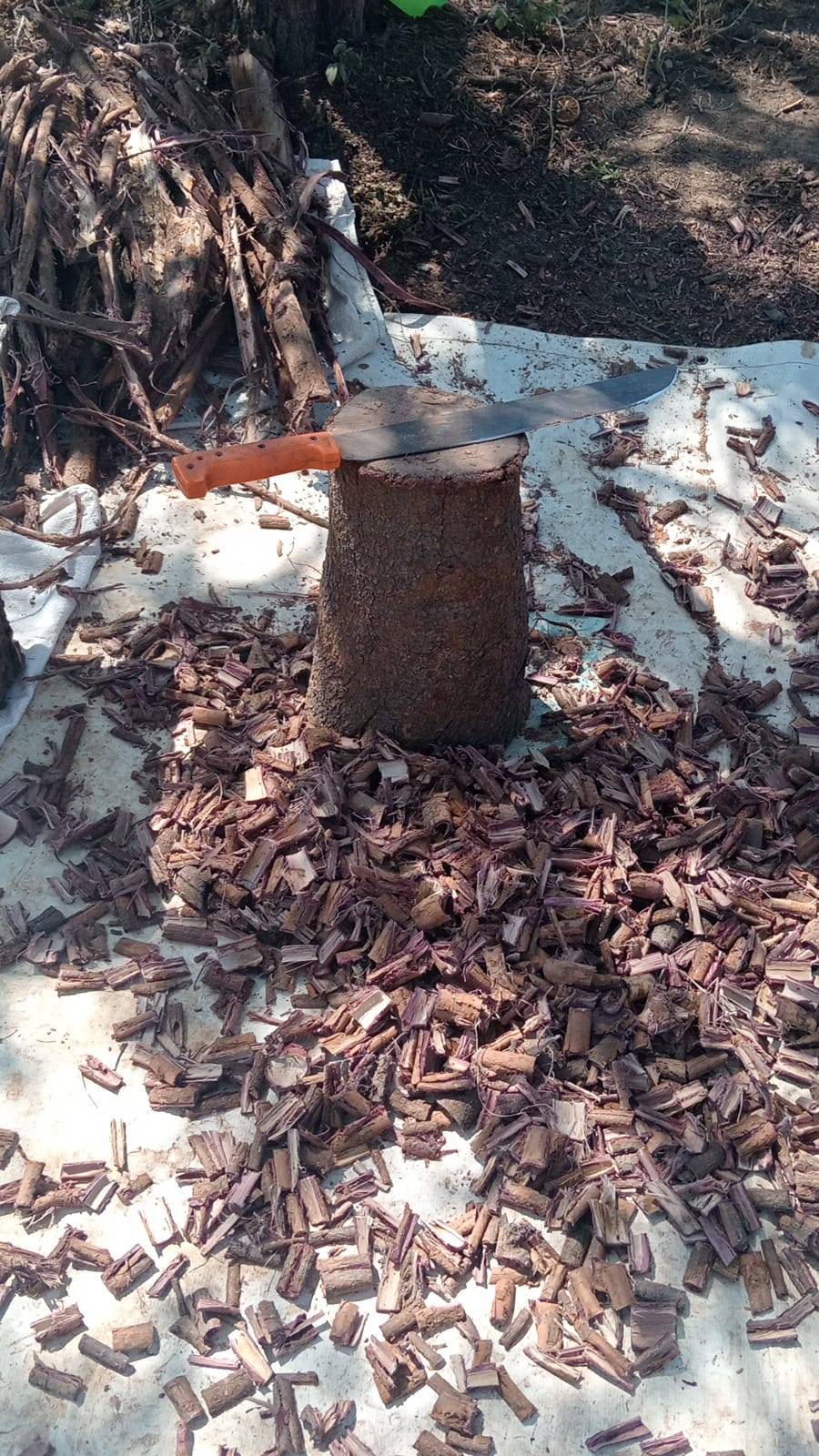
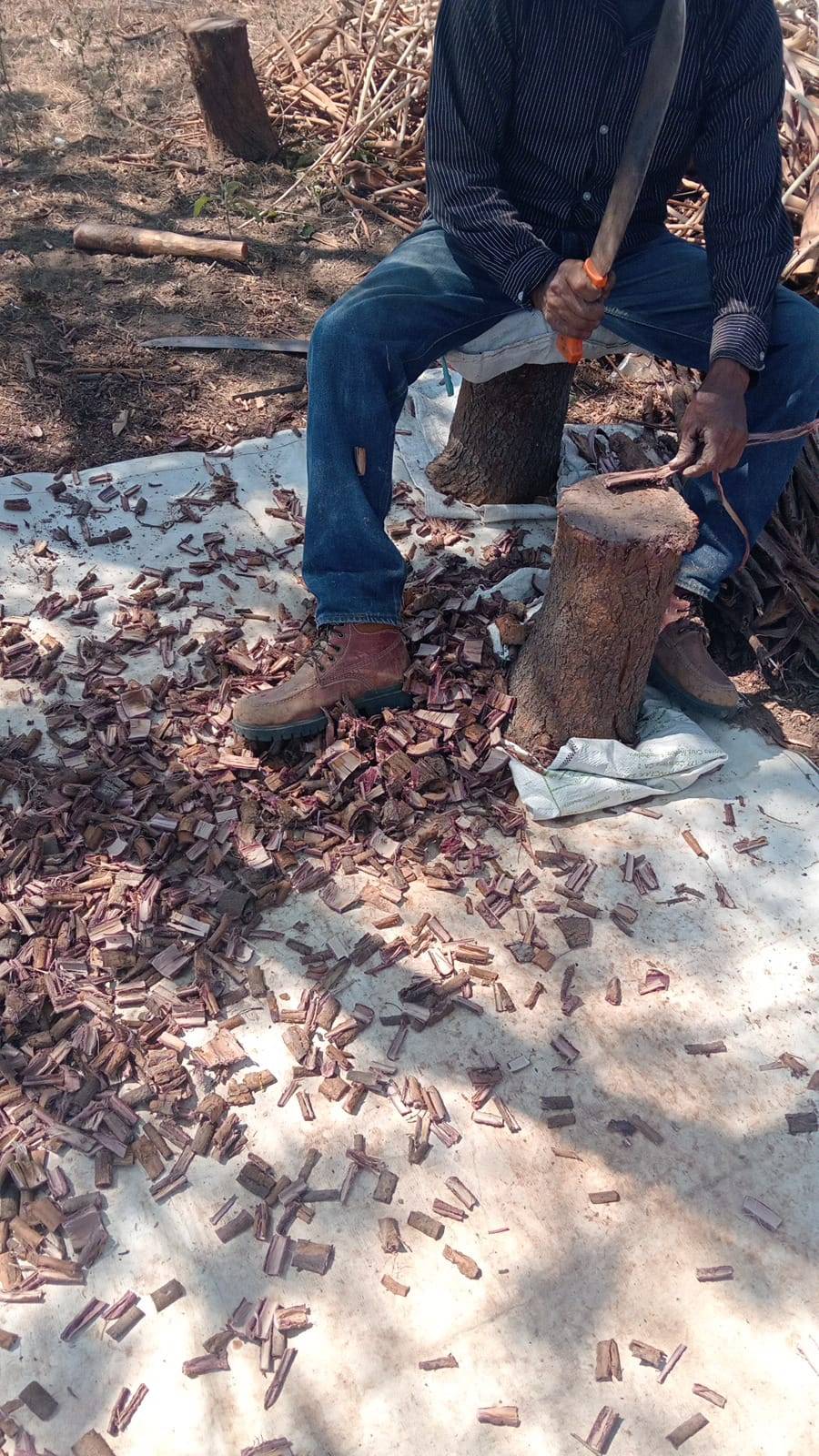
Harvesting Tepezcohuite root bark is manual, skilled work. There is no machinery that performs it well and no shortcut that doesn't show up in the quality of the final material. What you see in the photographs here is what every reputable harvest looks like: one person, one sharp blade, and a root that has been in the ground for years.
Timing Is the First Discipline
Harvest happens in the dry season — when the tree has slowed its active growth, pulled its resources inward, and concentrated its tannins and bioactive compounds into the root bark at their highest seasonal levels. Harvesting during the wet season, when the tree is actively pushing new growth, dilutes those concentrations. The material is less potent. The color is shallower. The performance in dyeing, soap making, and skincare formulation reflects it.
Maturity Is the Second Discipline
Trees younger than three years are left alone. Their root systems haven't yet developed the compound density that makes the harvest meaningful, and taking them early compromises the stand's long-term productivity. Mature trees of three to five years or more are selected deliberately — and even then, only portions of the root system are exposed at a time. Responsible operations leave a significant portion of the root mass intact, cover the exposed roots after harvesting, and allow the tree at least a full growing cycle before returning to the same plant.
Once roots are carefully uncovered, the outer bark comes off first — scraped or peeled away to reveal what lies directly beneath. The outer bark is fibrous and relatively inert. It contains some structural tannins and lignins, but it is not what this process is oriented around. The inner bark is what every step is built toward: a thin, dense layer pressed between the woody root core and the rough exterior, darker and more tightly grained than anything surrounding it. In good material, freshly stripped, it carries that unmistakable flash of red-purple — the visible signature of high tannin and phenolic density.
The inner bark is peeled away in long strips using sharp, clean blades. The motion is precise — closer to careful woodworking than brute-force harvesting. Speed matters less than accuracy. The goal is to take the inner layer cleanly without cutting into the root core itself, which would damage the tree's ability to regenerate.
From Strip to Chip — Processing on Site
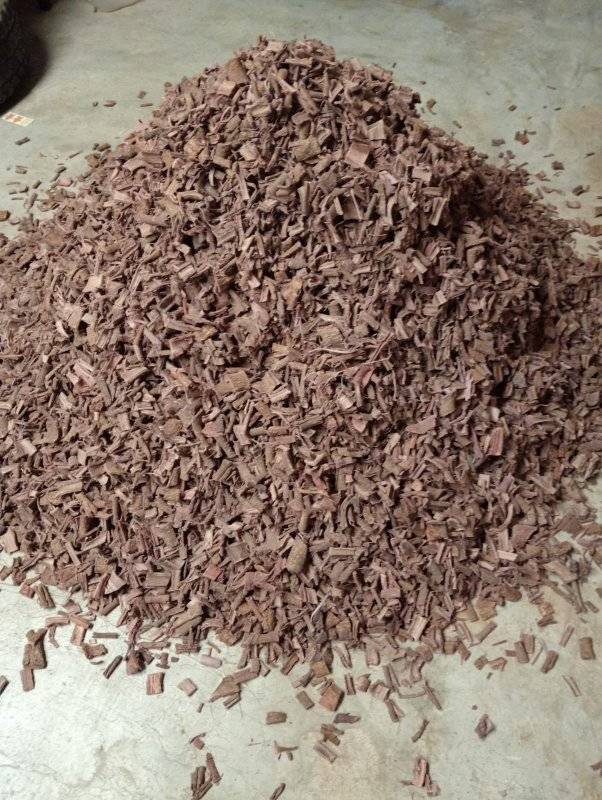
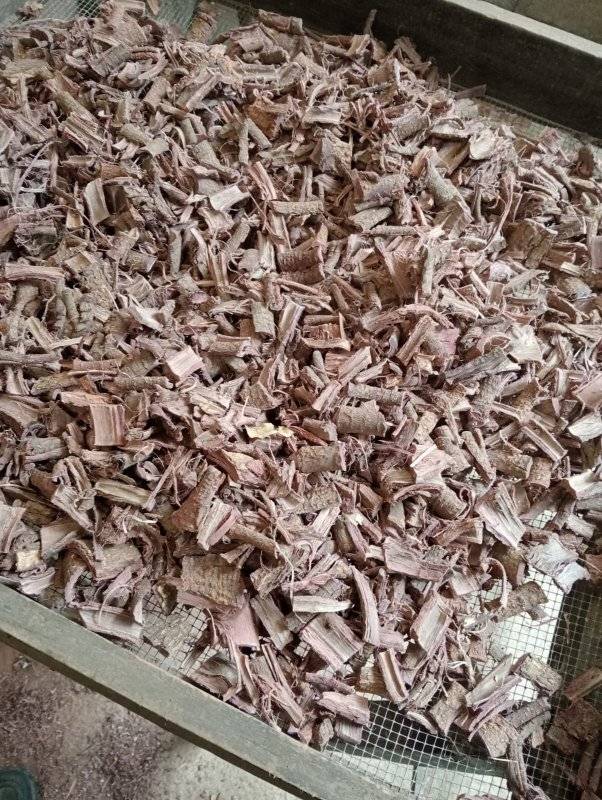
Once stripped, the inner bark is cut or broken down into its final form — chips, shredded material, or pieces destined for milling into powder. The freshly harvested bark carries significant moisture from the root and must be dried carefully before it is ready to use or ship.
Drying is done in shaded, well-ventilated conditions away from direct UV exposure. High heat and direct sunlight degrade the same tannins and phenolics that make the material valuable. Depending on local conditions and the thickness of the pieces, the process takes days to weeks. Nothing is added. Nothing is removed.
The color, the depth of pigmentation, and the performance in the hands of a soap maker, dyer, or skincare formulator all trace back to those original conditions — the soil, the season, the maturity of the tree, and the care of the hands that worked the roots.
Why the Inner Bark Distinction Matters
The inner root bark distinction is not a marketing qualifier. It is a meaningful difference in what the material actually contains and how it performs. Outer bark, whole root, stem bark, and true inner root bark are sometimes sold interchangeably or mislabeled across the market. True inner root bark arrives as thin, flexible strips or curled pieces, deep in color — not coarse uniform chunks or powder without documented origin. The photographs in this article show exactly how it is produced, in the ecosystem where the tree has developed its chemistry across centuries of unbroken tradition.
We source from established operations in the Selva Baja Caducifolia that practice selective, rotational harvesting. We do not source from operations that strip entire root systems or harvest immature stands. The material we carry is chosen for consistency — the color, density, and performance that our customers in soap making, natural dyeing, and botanical skincare depend on, batch after batch.
From Chiapas's dry highland depression. From the ecosystem the Maya have understood for a thousand years. Tepezcohuite is not a trend.
It is one of the most documented botanical materials in the Americas — and the ground it grows in is a significant part of why.
The bark behind the article.
Inner root bark only. Chips, shredded, and powder — sourced from the Selva Baja Caducifolia. Ships same day from the USA.
Shop MHRBFrequently Asked Questions
Why does Chiapas produce better bark than other regions?
The Selva Baja Caducifolia of Chiapas combines low ambient humidity, calcareous free-draining soils, and a pronounced dry season — conditions that maximize tannin concentration in the root bark while minimizing fungal pressure on the root system. The result is consistently potent, deep-colored material that outperforms bark grown under more humid conditions.
What is Tepezcohuite?
Tepezcohuite is the Mayan name for Mimosa hostilis — translated roughly as "the skin tree." It has been used by indigenous communities in Chiapas for centuries and was formally recognized as part of Mexico's national botanical heritage after its use in the aftermath of the 1985 Mexico City earthquake.
Why does the dry season matter for harvest timing?
During the dry season, the tree is not actively pushing new growth. It pulls its resources downward, concentrating tannins and bioactive compounds in the root bark at their highest seasonal levels. Wet-season bark is measurably less potent — the chemistry is diluted by the tree's active growth cycle.
How do you verify you're receiving true inner root bark?
True inner root bark presents as thin, flexible strips or curled pieces with a characteristic deep red-purple coloration when fresh. It is distinctly different from outer bark, which is fibrous and brown, and from stem bark, which lacks the compound density of root material. We work directly with sourcing partners who provide traceable, documented batches — not commodity bulk material of uncertain origin.
Is the harvesting sustainable?
The operations we source from practice selective, rotational harvesting — exposing only portions of each tree's root system, leaving significant root mass intact, and returning to the same plant only after a full growing cycle. No immature trees are harvested. This approach keeps productive stands healthy across multiple seasons rather than depleting them for short-term yield.