Understanding why Jurema bark performs this way — and how to work with it effectively — starts with knowing what is actually happening at a molecular level when bark meets hide.
One Plant. Two Jobs. One Chemistry.
The leather industry divides tanning and dyeing into separate operations almost universally. You tan the hide to stabilize it, then dye it to give it color. Different chemistry, different baths, different stages. This separation exists because most natural colorants don't interact with collagen in a meaningful structural way — they coat the surface without forming the molecular bonds that tanning requires. And most tanning agents, even botanical ones, produce a relatively pale, neutral result that needs separate dyeing afterward.
Jurema bark sits at the precise intersection of both functions because its dominant active compounds — condensed tannins, specifically prorobinetinidin polymers — are simultaneously excellent tanning agents and deeply pigmented colorants. The same molecule that cross-links with collagen fibers to stabilize the hide also carries the chromophore groups that absorb light and reflect the deep reddish-brown tone the bark is known for.
The same molecule that cures the hide is the molecule that colors it. You are not running two processes. You are running one, and the chemistry handles both ends.
This is not unique to Jurema in principle — all condensed tannins carry some color — but Jurema bark's particularly high polyphenolic concentration, combined with its specific flavonoid profile, produces color depth that most botanical tanning agents simply don't match. Oak-tanned leather is pale and nearly neutral. Jurema-tanned leather comes out of the bath already warm, red-toned, and rich.
The Science — What Condensed Tannins Actually Do
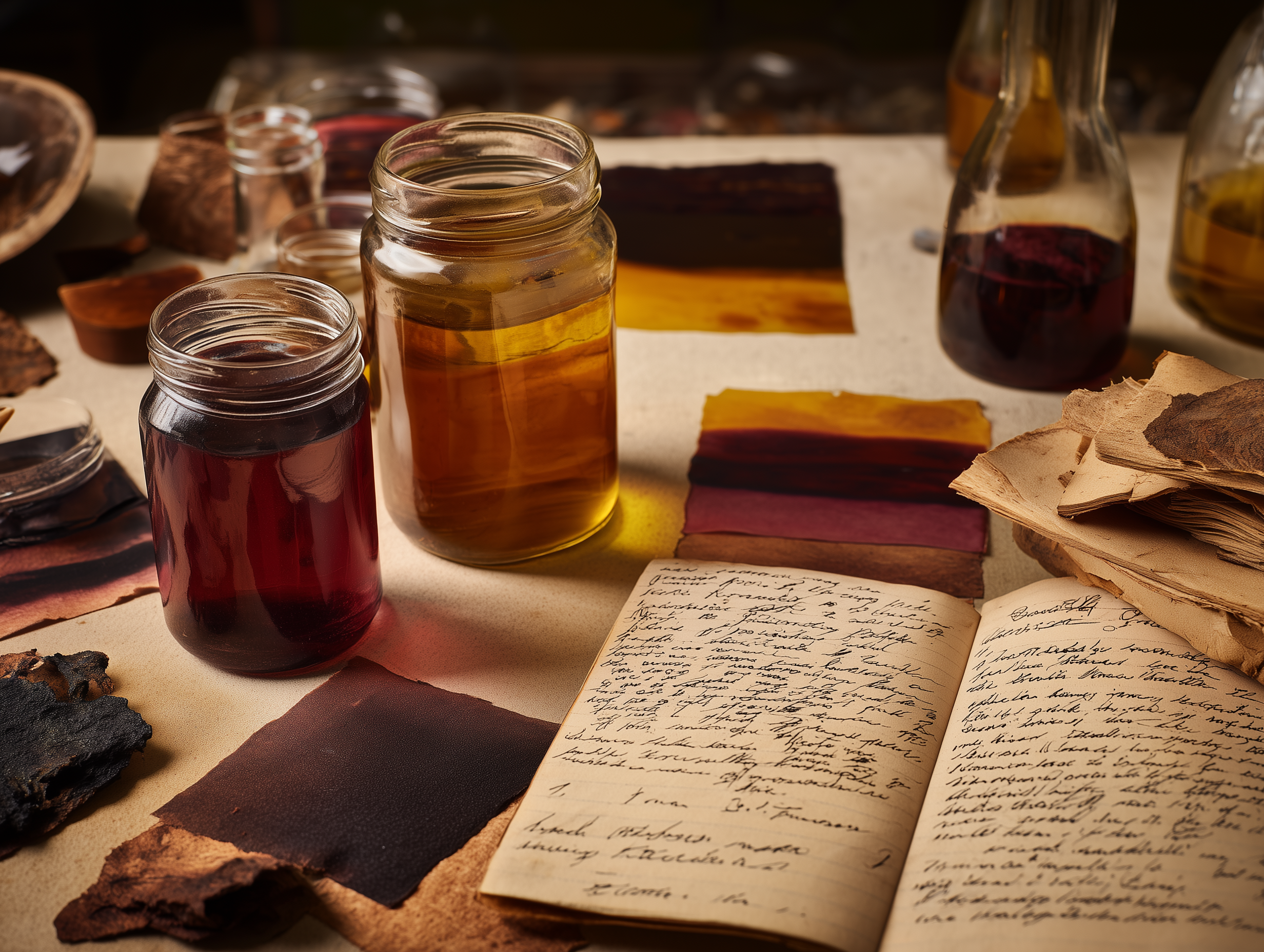
Raw animal hide is primarily composed of collagen — a fibrous structural protein with a triple-helix molecular architecture. Untreated, collagen is unstable: it decomposes, stiffens when wet, and provides no resistance to microbial breakdown. Tanning converts this unstable protein matrix into durable leather by introducing compounds that cross-link the collagen fibers and occupy the spaces between them, preventing collapse and decomposition.
Condensed tannins — the class Jurema bark belongs to — accomplish this through hydrogen bonding and hydrophobic interactions with the peptide backbone of collagen. The tannin molecules are large enough and structurally complex enough to bridge multiple collagen chains simultaneously, creating a three-dimensional network that is both stable and flexible. This is the same mechanism that makes quebracho, mimosa wattle, and chestnut bark effective commercial tanning agents.
What the Research Confirms
Peer-reviewed solid-state NMR spectroscopy of vegetable-tanned leathers has confirmed that Mimosa-family condensed tannins leave a distinct molecular fingerprint in the finished leather — one that is faithfully reproduced in the collagen matrix of the hide, demonstrating genuine chemical incorporation rather than surface deposition. The primary tannin in Jurema bark is a prorobinetinidin polymer — a specific subclass of condensed proanthocyanidin with particularly strong protein-binding affinity and natural red-brown pigmentation.
Tannin concentration in Jurema inner root bark has been measured at levels comparable to quebracho, one of the most widely used commercial tanning agents globally. The combination of high tannin concentration and natural chromophore-bearing compounds makes it functionally unique among accessible botanical tanning materials.
Veg-Tan vs. Chrome-Tan — Why It Matters
Not all leather responds equally to Jurema bark, and the distinction between vegetable-tanned and chrome-tanned leather is the single most important variable in determining your results.
Vegetable-tanned leather — often called veg-tan — is processed using plant-derived tannins and retains a porous, reactive surface chemistry. Its collagen network already contains tannin molecules from the original tanning process. When you introduce Jurema bark as a dye bath, the new tannins penetrate and bond with that existing structure, producing deep, lasting color that works with the leather rather than sitting on top of it. The result is genuinely colorfast, penetrating, and improves with age as the tannins continue to oxidize and darken.
Chrome-tanned leather is processed using chromium salts rather than plant tannins. Its surface chemistry is fundamentally different — it doesn't share the protein-tannin affinity that makes veg-tan so receptive. Jurema bark will still deposit some color on chrome-tanned leather, but the bond is weaker and the color is more prone to surface rubbing and fading over time. If chrome-tanned leather is what you have, applying a tannic acid pre-treatment can meaningfully improve absorption before the Jurema bath.
| Property | Veg-Tan + Jurema | Chrome-Tan + Jurema |
|---|---|---|
| Color depth | Deep, penetrating | Surface-level, lighter |
| Bond type | Molecular — tannin to collagen | Weak — requires pre-treatment |
| Colorfastness | High — improves with age | Moderate — can rub off |
| Character | Rich, warm, develops patina | Flat, less depth over time |
| Pre-treatment needed | None | Tannic acid mordant recommended |
The Color You Can Expect
Jurema bark does not produce a single, predictable hue. The color you get from the same bark can shift significantly depending on four variables: the concentration of your bark extract, the pH of your bath water, the mordant you use, and the duration of immersion.
An acidic bath (pH below 5) tends to produce lighter, warmer red-tan tones. Moving toward neutral or mildly alkaline conditions shifts the color into deeper reddish-browns. An iron mordant applied after the Jurema bath — a technique historically called "saddening" — reacts with the residual tannins in the leather and drives the color significantly darker, toward near-black mahogany tones. This is the same chemical reaction that occurs naturally when iron nails corrode in contact with oak, producing those characteristic dark stains. With Jurema bark you are applying that process intentionally and with control.
The Process — Step by Step
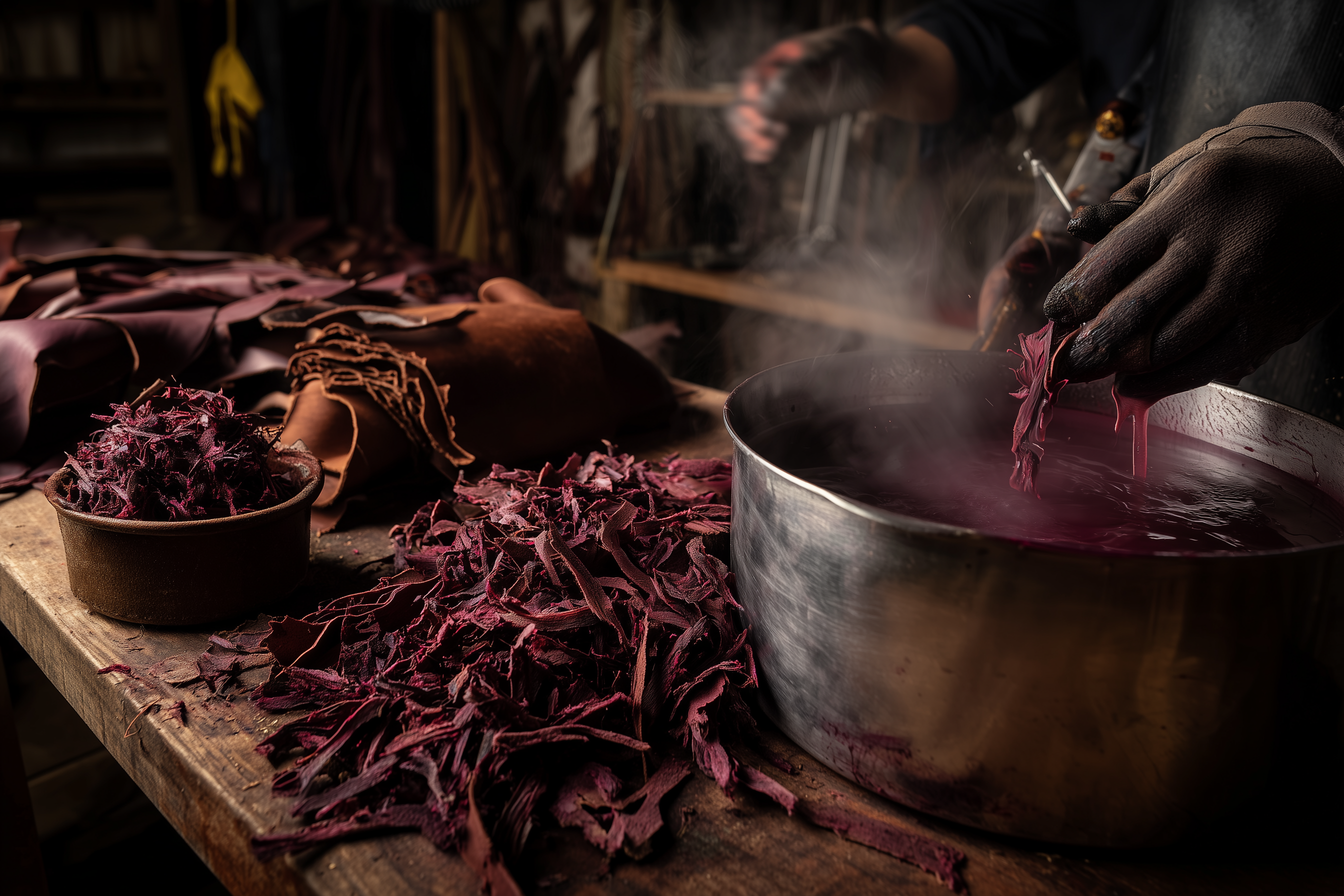
Extract the Bark
Simmer Jurema bark in water for a minimum of 45 minutes to one hour. The water should turn a concentrated, deep reddish-brown. Strain out all bark material completely — any solids left in the bath can mark the leather unevenly. For a stronger dye, increase the bark-to-water ratio or extend the simmer time. Soft or filtered water produces cleaner color; mineral-heavy water can cause tannins to precipitate and muddy the result.
Prepare the Leather
Start with raw, unfinished vegetable-tanned leather. Any oils, waxes, or surface finishes already on the leather will block penetration. Dampen the leather lightly with clean water before introducing it to the dye bath — dry leather absorbs unevenly, creating blotchy results. A light, even misting opens the surface and allows the tannins to penetrate uniformly.
Introduce to the Bath
The dye bath should be warm but not actively boiling — excessive heat can stiffen and damage leather fibers. Submerge the leather and monitor color development every 10 to 15 minutes. Jurema bark color develops progressively; patience consistently produces better results than rushing. Turn the leather periodically to ensure even exposure on all surfaces.
Remove and Dry Slowly
Once you reach the desired depth of color, remove the leather and allow it to dry at room temperature, away from direct sunlight. UV exposure during drying can cause uneven fading before the tannins have fully set. The color will deepen slightly as it dries and the tannins oxidize — factor this in when pulling the leather from the bath.
Condition After Drying
Apply a quality leather conditioner after the piece is fully dry. The dyeing process displaces natural oils from the leather's fiber structure, and skipping this step leads to brittleness and cracking over time. Neatsfoot oil, beeswax-based conditioners, and leather balm all work well. The conditioner also slightly deepens the final color and adds a natural sheen.
Optional — Iron Mordant Saddening
For darker tones, apply an iron mordant solution after drying. Iron water (made by soaking steel wool in a water-vinegar solution for several days) reacts with the residual tannins in the leather and shifts the color significantly toward deep brown and near-black. Apply sparingly with a cloth and work in sections — iron is difficult to reverse once it has reacted with the tannin.
Why This Matters Beyond the Workshop
The conventional leather industry relies heavily on chrome tanning — fast, industrial, and effective at producing soft leather, but generating toxic effluent containing chromium compounds that require expensive waste treatment before safe discharge. Synthetic finishing dyes add additional chemical complexity to an already burdened process.
Jurema bark offers something the industry is increasingly looking for: a single botanical source that handles both structural tanning and color in one biodegradable process. The tanning liquors it produces break down naturally and introduce no heavy metals or persistent synthetic compounds into wastewater. The plant itself grows quickly, coppices well — meaning it regrows after harvest without being killed — and can be sourced from operations that practice rotational harvesting without damaging productive stands.
For artisan leather workers, slow-fashion producers, bookbinders, and natural dye practitioners, these properties translate directly into a cleaner, more transparent production story. A piece tanned and dyed with Jurema bark can be described with full accuracy as processed with a single plant-based material, without synthetic additives or separate chemical steps. In a market where material transparency is increasingly valued, that is a meaningful distinction.
A piece tanned and dyed with Jurema bark can be described with complete accuracy as processed with a single plant-based material. That kind of simplicity is almost impossible with any other botanical.
Ready to work with it yourself?
Inner root bark only. Chips, shredded, and powder — sourced from Chiapas. Ships same day from the USA.
Order Now Questions? Text us anytime — 213-973-2658Frequently Asked Questions
Does Jurema bark really tan and dye at the same time?
Yes. The condensed tannins in Jurema bark bind chemically with collagen fibers in the hide — the same structural interaction that makes vegetable tanning work — while the natural polyphenolic pigments simultaneously deposit color throughout the leather. Both actions are carried out by the same molecular compounds in the same bath.
What leather type works best?
Vegetable-tanned leather is by far the most receptive. Its existing tannin-collagen matrix creates near-ideal conditions for Jurema bark absorption — the color penetrates deeply and bonds permanently. Chrome-tanned leather will take some color but the result is less deep and less durable without a tannic acid pre-treatment.
How do I get darker tones?
Three approaches: increase the concentration of bark in your dye bath, extend immersion time, or apply an iron mordant solution after dyeing. Iron reacts with the residual tannins in the leather and shifts the color toward deep brown and near-black. These approaches can be combined for the deepest results.
Is the color permanent?
Jurema bark produces relatively high colorfastness compared to most natural dyes, largely because the tannin-collagen bond is genuinely molecular rather than surface-level. With proper finishing — particularly the application of a UV-protective topcoat on pieces that will see significant sunlight — the color remains stable for years. Some gradual darkening and patina development with age is typical and considered a desirable characteristic of naturally tanned leather.
What equipment should I use?
Always use non-reactive vessels — stainless steel, glass, or enamel. Aluminum and copper pots introduce metallic ions into the dye bath and will unpredictably shift the color. Soft or filtered water produces the cleanest results. Keep detailed notes on bark ratios, simmer times, and mordants used so you can reproduce or troubleshoot results accurately.
Where does your bark come from?
We source true inner root bark from established, selective operations in the Selva Baja Caducifolia of Chiapas, Mexico — the same ecosystem where Tepezcohuite has been harvested for centuries. Rotational harvesting only. No immature trees. Ships same day from the United States. Read more about our sourcing here.