The Finding
We compared pieces with visible scaly exterior texture against clean pieces — across dye yield, color depth, and tannin extraction.
No meaningful difference.
Here is exactly why — and how decades of online mythology led buyers to mistake rough exterior patches for a quality problem that doesn’t exist.
A few rough, scaly patches on the exterior of your bark are not outer bark contamination. That idea is a myth — one that spread through online communities until it sounded like science. Here is why it isn’t, and what your bark actually is.
To understand what you are actually holding when you receive a piece of MHRB, we need to start where the original botanists started — at the trunk of the tree, looking at the bark from the outside in. Because what those early naturalists saw on the exterior of the trunk was a thick, black outer bark that looked almost like armor — and that is precisely what gave rise to the name hostilis. And that thick, black outer bark is precisely what is not on the pieces you receive.
The Armor Bark — What First Identified This Tree
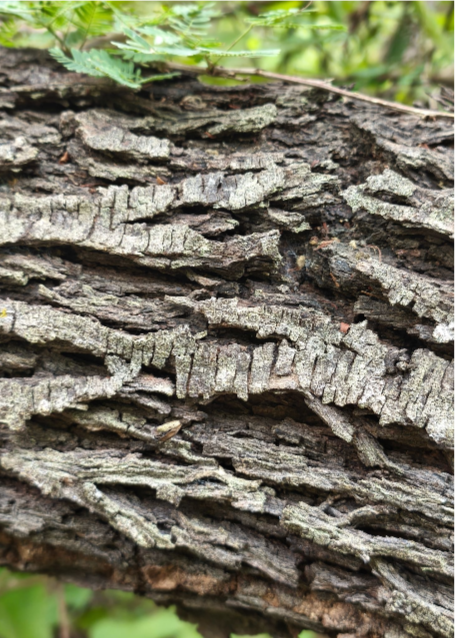
When Carl Friedrich Philipp von Martius encountered this tree in the Brazilian Caatinga in the early 1820s, what he saw first was its exterior. The trunk of a mature Mimosa hostilis is covered in a thick, deeply furrowed, almost armored bark — dark gray to near black, cracked into overlapping plates, rough and formidable. It was this exterior that gave him reason to name it Acacia hostilis: the hostile acacia. The thorns and the outer root bark together created an impression of a plant that did not welcome approach.
This thick outer layer is the rhytidome — the true outer bark of the trunk. It is composed of dead, suberized cork cells. It protects the living tissue beneath it from desiccation, UV radiation, temperature extremes, and physical damage. It is thick, prominent, and visually dominant on the trunk of the tree. And it contains essentially no tannins, no polyphenolic pigments, and no meaningful chemistry relative to what lies beneath it.
When people in online communities talk about “outer bark” reducing quality — this is what they are picturing. This thick, black outer root bark that coats the trunk. The same bark that gives Jurema Preta — “black jurema” — its name. This material is not in your order.
Inside the Tree — What the Cut Face Reveals
The photograph below shows exactly what happens when you cut through a Mimosa hostilis trunk. The rough outer bark is visible on the exterior edge. Beneath it, exposed on the cut face, is what you are actually after — the secondary phloem. Rich, reddish-brown to purple-pink, dense with tannins and pigment. This is the boundary between what forums have spent twenty years arguing about, and what every serious botanist has always known was the only thing that mattered.
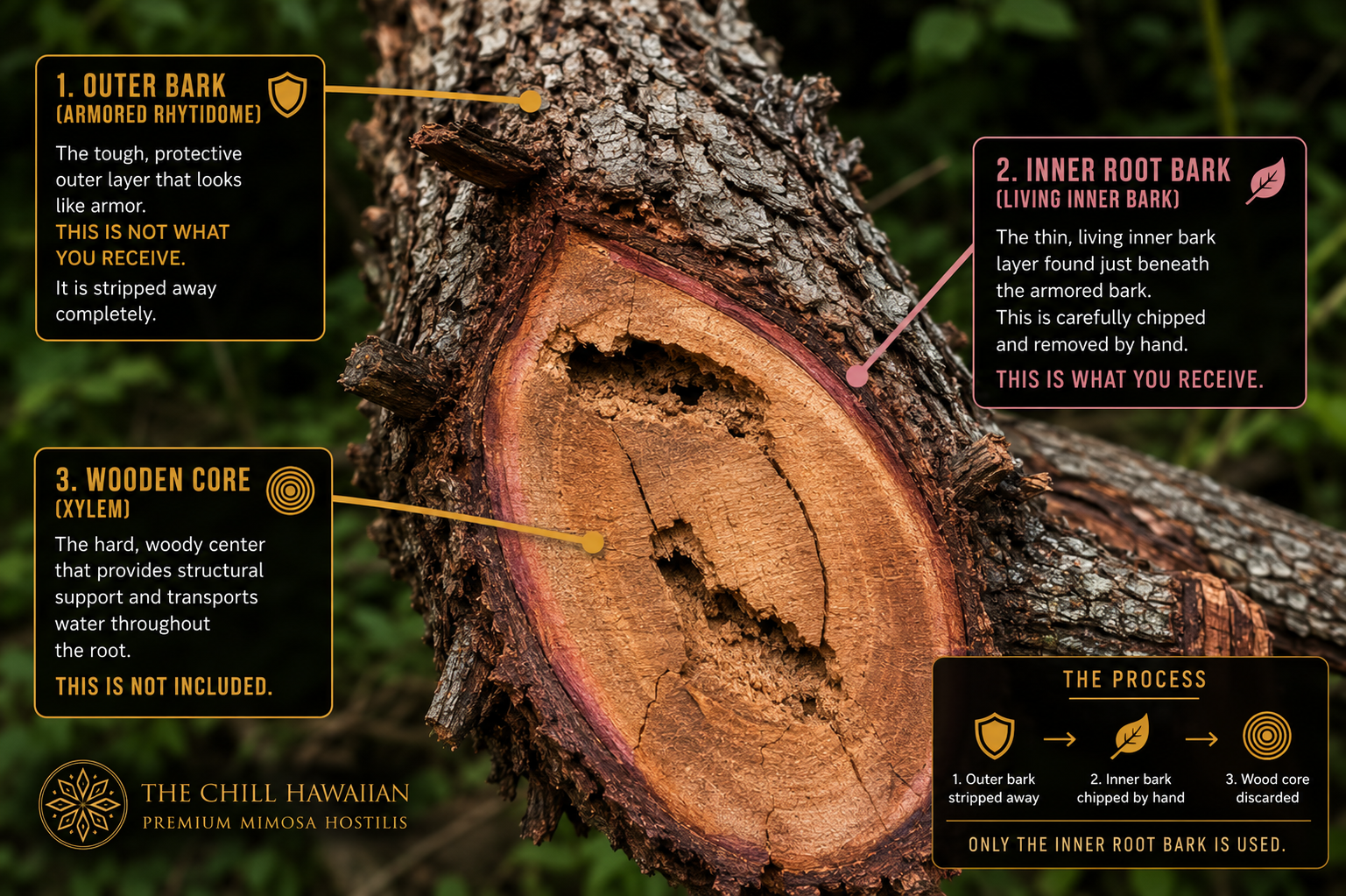
Cross section of Mimosa hostilis root bark. The dark outer surface is the rhytidome — the true outer bark. The reddish-purple layer beneath it is the secondary phloem — the true inner bark, rich in tannins and pigment, and what constitutes the pieces you receive. The pale center is the xylem wood core, removed at source before anything ships.
The Layers — From Trunk to Root
Here is the full anatomy of the plant, from outside to center — and critically, how each layer changes as you move from the visible trunk down into the root system where our material is harvested.
Rhytidome
Outer armor — trunk only
Thick on the trunk. Almost absent on root bark. The thick outer root bark you see in the photo above. On the trunk it can be centimeters thick, deeply furrowed, near black. As the root descends underground, this layer thins progressively — the underground environment offers none of the UV, temperature extremes, or mechanical stress that drive thick rhytidome development. By the time you are in the root system, the rhytidome has reduced to a thin, often patchy surface layer. On processed MHRB pieces, it is at most a few cells thick. It is inert. It contains no significant tannins or pigment.
Secondary Phloem
True inner bark — what you receive
This is the entire piece in your hands. The secondary phloem is the living bark tissue where Mimosa hostilis concentrates everything of value — tannins, polyphenolic pigments, flavonoids, arabinogalactan polysaccharides. It is fibrous, reddish-purple to deep pink on the interior face, and it is what every name for “inner root bark” was always trying to describe. When you look at a piece of MHRB — the dark, colored, fibrous material — you are looking at phloem. The thin scaly patches on the exterior face are residual rhytidome sitting on its surface. They do not change what the piece is.
Cambium
Boundary layer
A single layer of dividing cells between phloem and xylem. Appears as a pale line on a fresh cut. Generates new phloem outward and new wood inward. Not commercially significant.
Xylem
Woody core — removed at source
The pale yellow woody interior — actual wood, not bark. Low tannin content, no meaningful pigment, filler weight. This is the only genuine quality distinction worth making — bark versus wood. We remove the xylem core at source in Chiapas before anything is dried or shipped. It is not in your order.
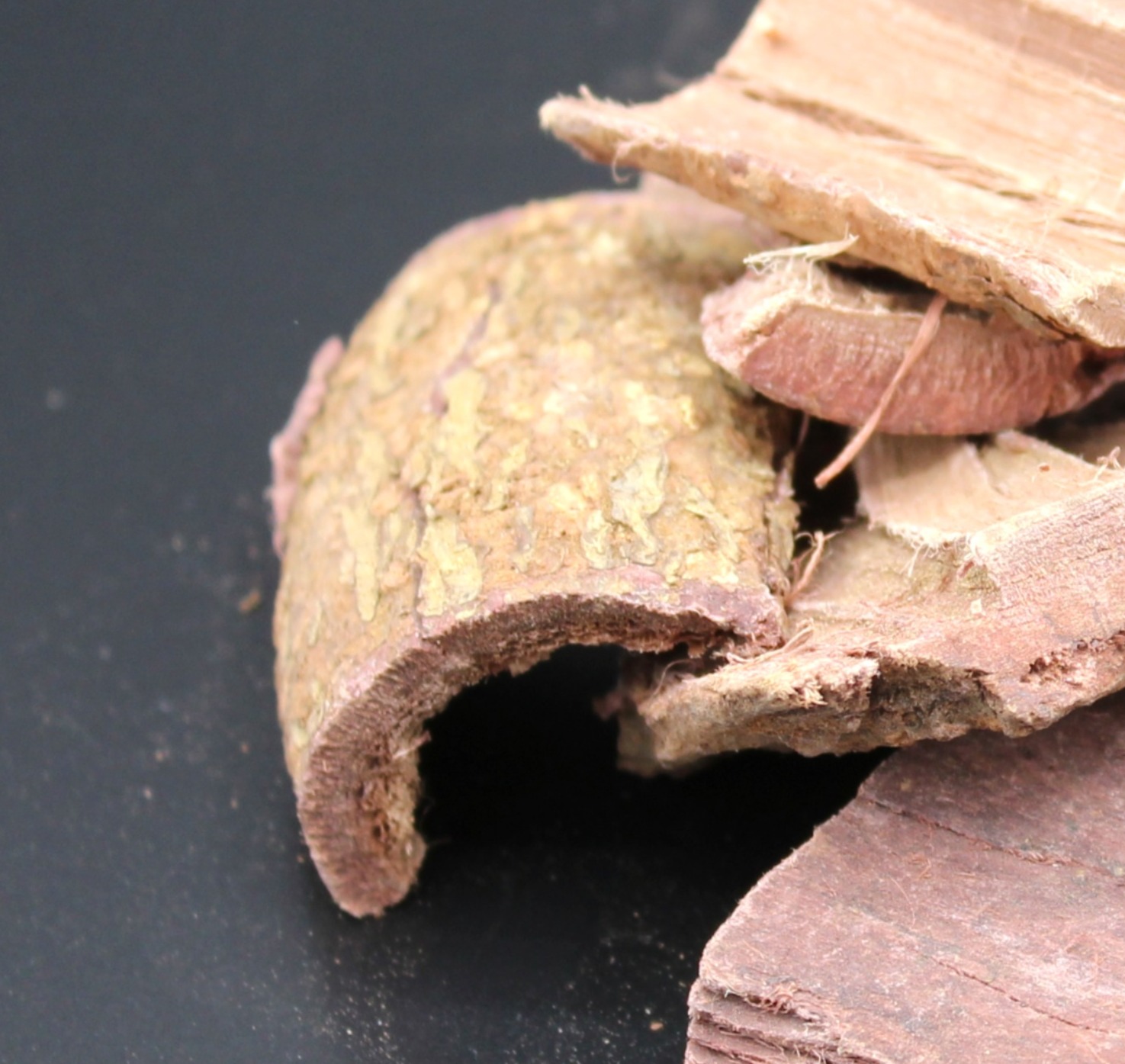
The exterior face of a processed MHRB piece. The scaly patches are residual rhytidome — a few cells thick, sitting on the phloem surface. Not the thick trunk armor. Not a quality issue.
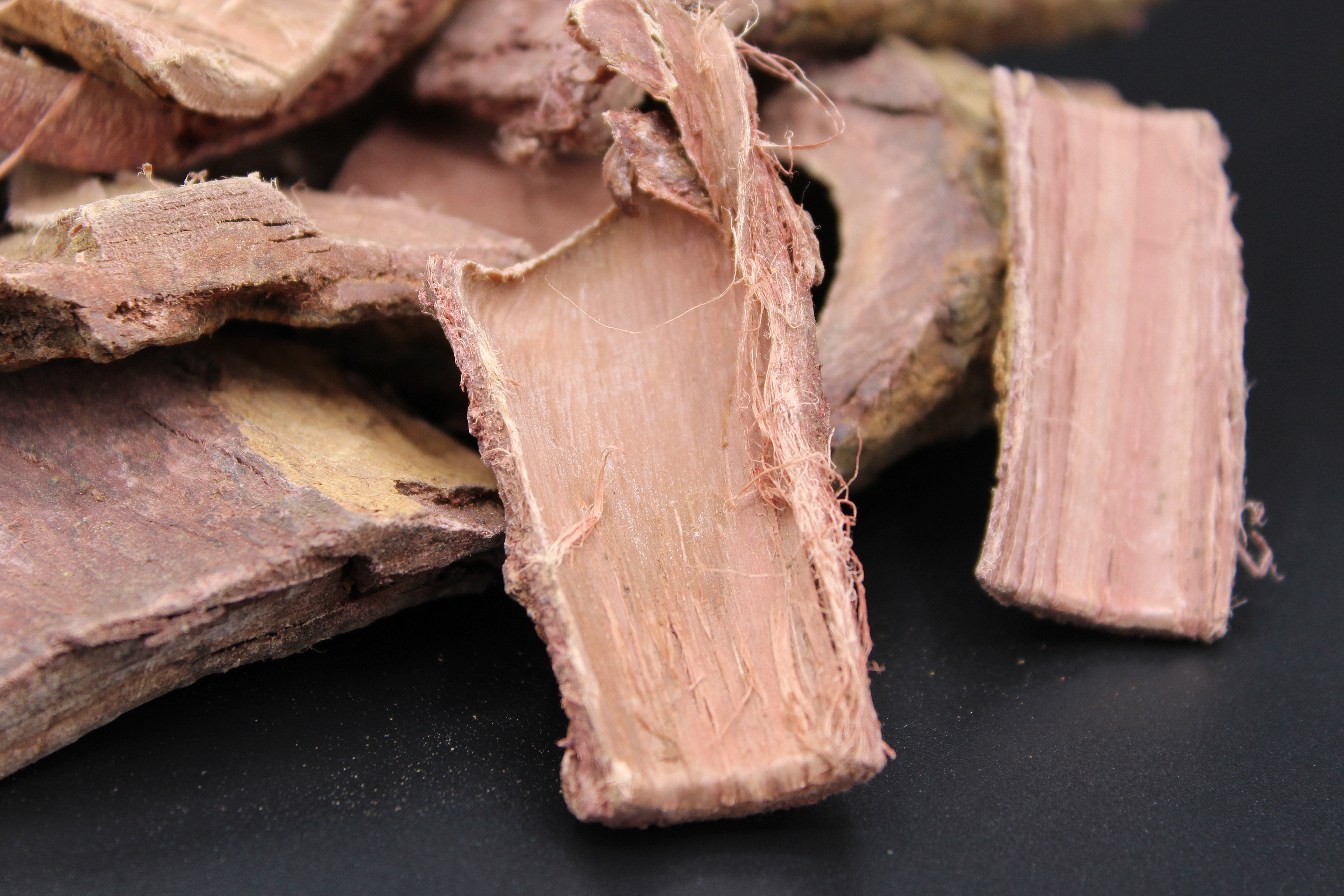
The interior face of the same piece — fibrous, reddish-purple phloem. This is the chemistry. This is what you are buying. Both faces are the same slab of secondary phloem.
The Myth — How a Real Problem Became the Wrong Answer
The true outer bark of Mimosa hostilis is unmistakable. Dark. Near-black. Thick and furrowed like old leather. It coats the trunk of the tree in plates — tough, protective, and visually striking. Nobody who has seen it would confuse it with what’s inside.
What happened in online communities over two decades is that the phrase “inner root bark” got repeated so many times, in so many threads, that buyers began to believe any visible exterior texture on their bark was this thick black armor coming through. A few patchy, thin cells on the outside face of a phloem slab — and people panicked. They called it contamination. They demanded cleaner product. They wrote guides distinguishing “true inner MHRB” from what they’d received.
None of it was grounded in botany. The confusion came from a legitimate place — certain vendors were adulterating product, cutting powder with filler, selling trunk bark as root bark, and disappearing with the money. That was real. But “outer bark contamination” became the language buyers used for every quality concern — including the totally normal, botanically unremarkable thin surface of genuine phloem. The two things got merged, and the mythology stuck.
The Black Jurema Pieces — What the Warnings Were Actually About
There is a genuinely different product category: large, thick, near-black pieces of trunk bark with a far higher ratio of outer bark to phloem. These are sometimes called black jurema pieces. They are darker, harder, and visually dramatic — which is exactly why some vendors marketed them as premium. They are not.
These pieces are not part of our product. We source exclusively from the root system, where the outer bark has thinned dramatically before harvest. A few residual surface cells on the face of a phloem slab are not a black jurema trunk piece. They are what root bark looks like. Full stop.
70–90% of Pieces Have Visible Surface Texture — Here Is What That Means
Our Testing — Confirmed
We’ve run side-by-side comparisons — pieces with more of that rough, scaly exterior surface versus pieces with almost none of it. The results were consistent across dye yield, color depth, and tannin extraction. No meaningful difference.
Around 70–90% of pieces in a typical batch will show some visible residual surface texture on the exterior face. If you see some of these thin surface cells on your pieces — rest assured, they are not significant and do not contribute to any reduction in quality. They are not the thick outer root bark of the trunk. They are a thin surface residue sitting on top of the phloem you purchased. This is normal, expected, and botanically unremarkable.
Those thin residual cells are still technically a part of the bark structure. All of the thick outer trunk bark has already been left behind. What arrives is true inner bark — deep with tannins and pigment, doing exactly what this plant has always done.
The Real Quality Variables
What Actually Affects Performance
Harvest season: Tannin density varies significantly with seasonal water stress. Dry season harvest consistently produces higher phenolic concentrations. Our material is harvested in the dry season from the Selva Baja Caducifolia of Chiapas.
Cellular density and soil conditions: Bark from plants grown in particular soil compositions develops differing cellular architecture. Denser cellular structure means compounds are held more tightly within cell walls and require different extraction conditions to release. This is botanical variation — not a quality defect.
Wooden core removal: The only separation that genuinely matters. Wood is not bark. We remove it at source.
Residual surface texture: Not a quality variable. Confirmed through direct testing across multiple batches.
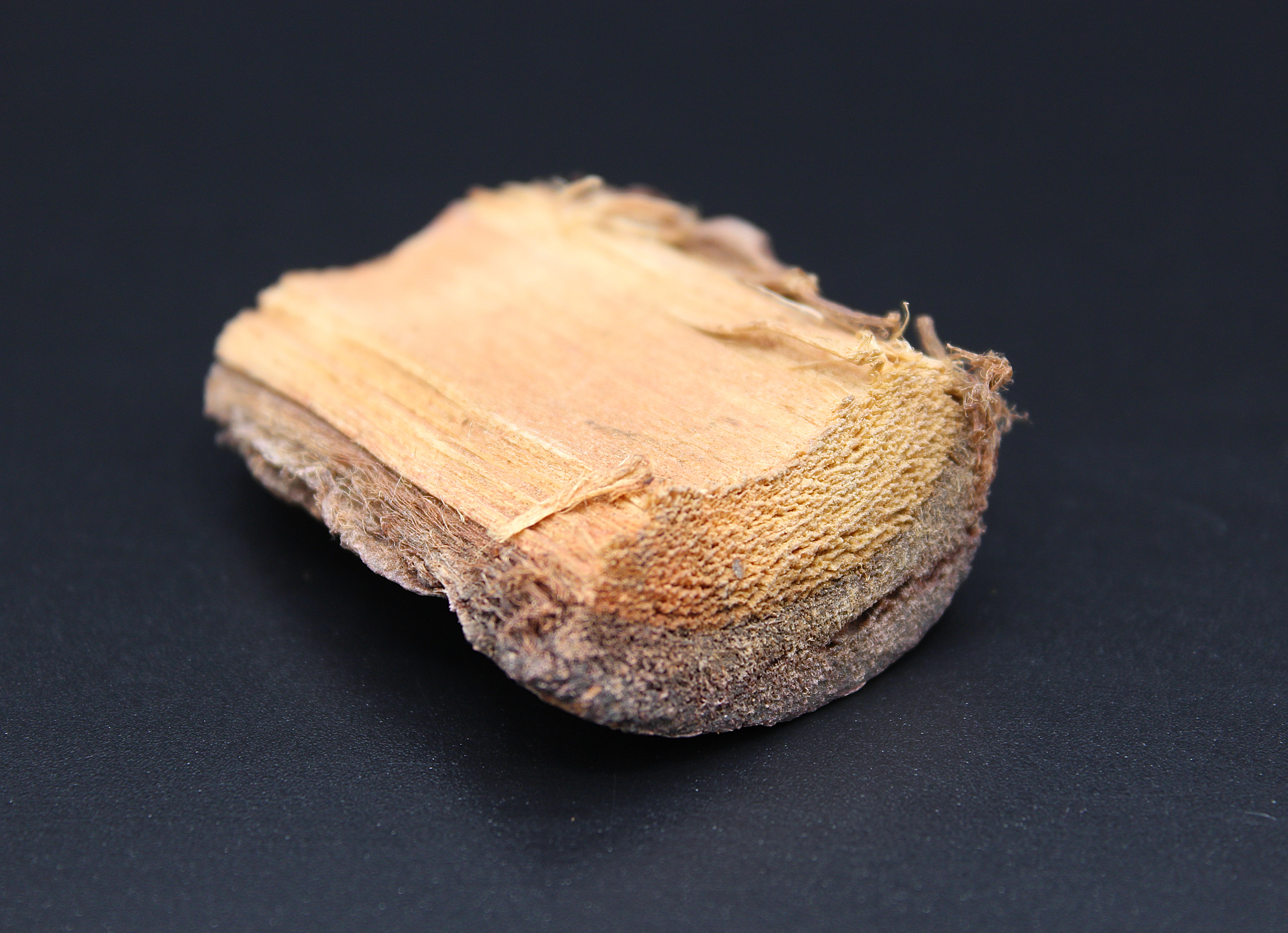
The pale wooden core still attached — the only separation that genuinely matters. Wood is not bark. This does not ship in your order.
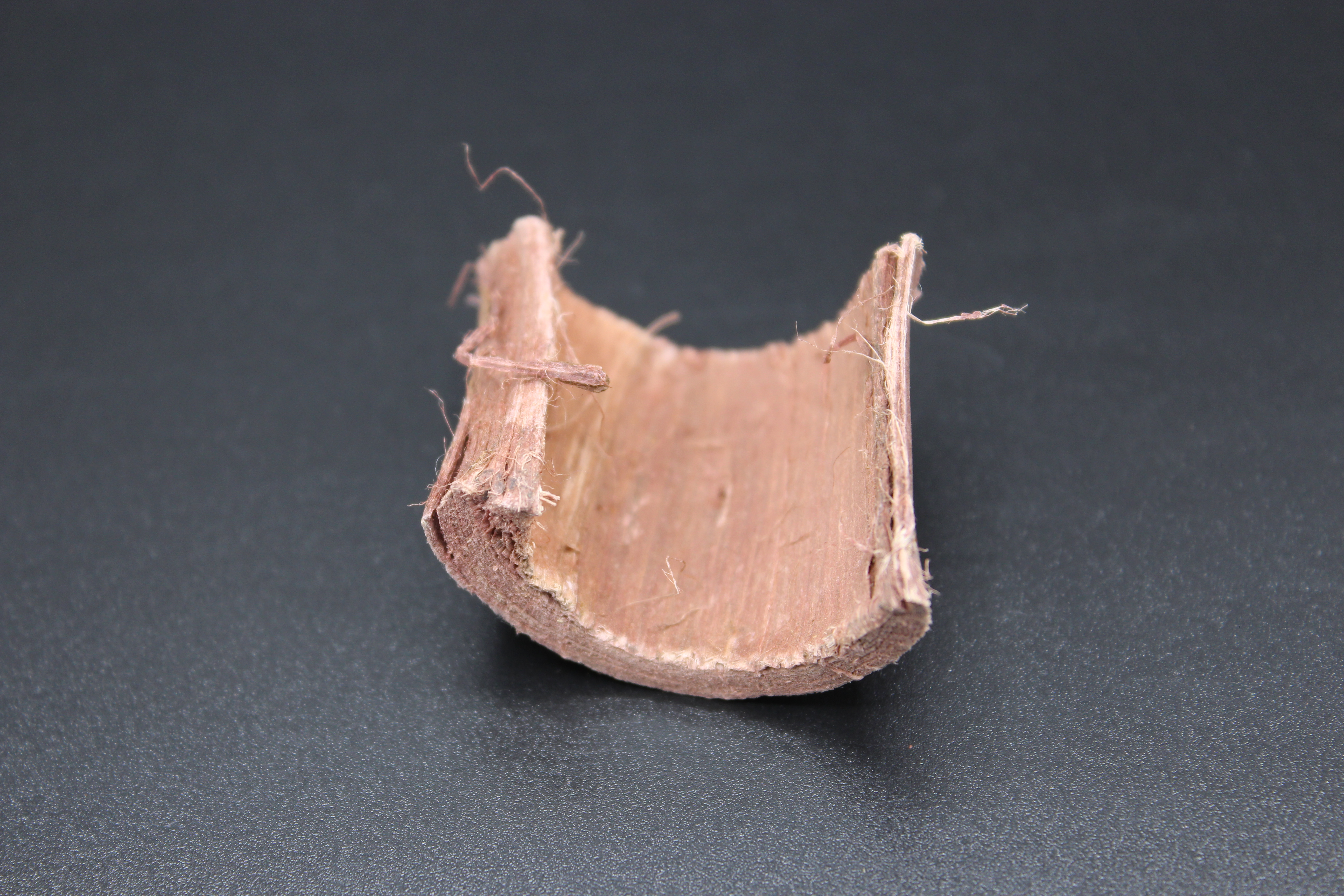
Pure secondary phloem after core removal. Dense, pigmented, tannin-rich. Residual surface texture on the exterior does not change what this is.
What You Receive — Guaranteed
Wooden core: Removed at source in Chiapas. Not in your order.
Secondary phloem: The entire piece. Tannin-rich, deeply pigmented, dry season harvest from root material.
Residual surface texture on 70–90% of pieces: Normal, expected, tested, and confirmed not to affect quality by any measure we have applied.
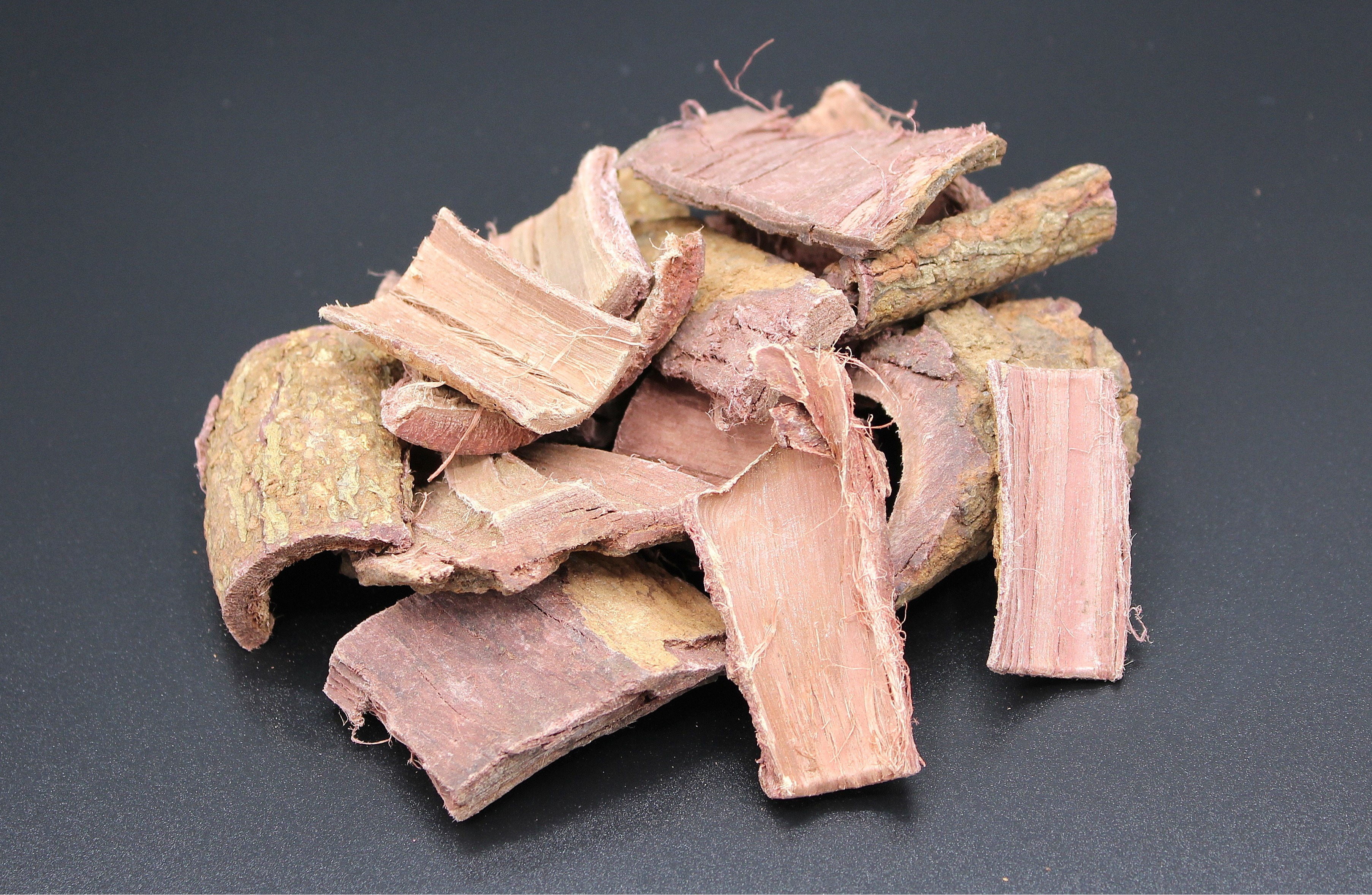
A typical batch. Pieces with residual surface texture, pieces without, variation in pigmentation and fiber. All secondary phloem. All from the root system. All the same chemistry.
The Psychology of Working With Botanical Dye
There is something worth acknowledging that rarely gets said plainly: how you approach a botanical dye specimen has a measurable effect on your results. Not in a mystical sense — in a deeply human one.
Dye work with Mimosa hostilis involves variables that respond to attention. Water temperature, mordant ratios, soak time, fiber preparation, agitation rhythm — all of it requires presence. Practitioners who approach the dye bath with care and genuine curiosity consistently report richer, more complex results than those who rush the process or approach it clouded by doubt about product quality.
This is not placebo in the dismissive sense. It is placebo in the precise scientific sense: expectation shapes perception, perception shapes behavior, and behavior shapes outcome. A dyer who believes their bark is compromised will treat it differently — less time, less trust, less attention — and the result will reflect that. A dyer who trusts their material and commits fully will give it what it needs.
The plant is not the only variable in the dye bath. You are.
This opens into broader territory — the relationship between botanical tradition, psychological state, and material outcome — that we intend to explore in future journal entries. How cultures that worked with these plants for centuries understood this intuitively. How modern evidence-based research is only beginning to catch up. And what it means to work with a substance whose effects cannot be separated from the attention you bring to it.
Root bark. No mythology.
Wooden core removed at source. Dry season harvest from Chiapas root material. Chips, shredded, and powder — ships from the USA.
Order MHRB Now
References & Further Reading
- Esau, K. (1977). Anatomy of Seed Plants, 2nd ed. John Wiley & Sons.
- Souza, R.S. et al. (2025). Seasonal effect on the chemical composition of Mimosa tenuiflora stem bark. Chemistry & Biodiversity.
- Meckes-Lozoya, M. et al. (1990). Pharmacological properties of various extracts of Mimosa tenuiflora. Archives of Medical Research, 21(2), 163–169.
- Zippel, J., Deters, A., & Hensel, A. (2009). Arabinogalactans from Mimosa tenuiflora stimulate dermal fibroblasts in vitro. Journal of Ethnopharmacology, 124(1), 93–99.
- Taiz, L. & Zeiger, E. (2010). Plant Physiology, 5th ed. Sinauer Associates.